The first frames
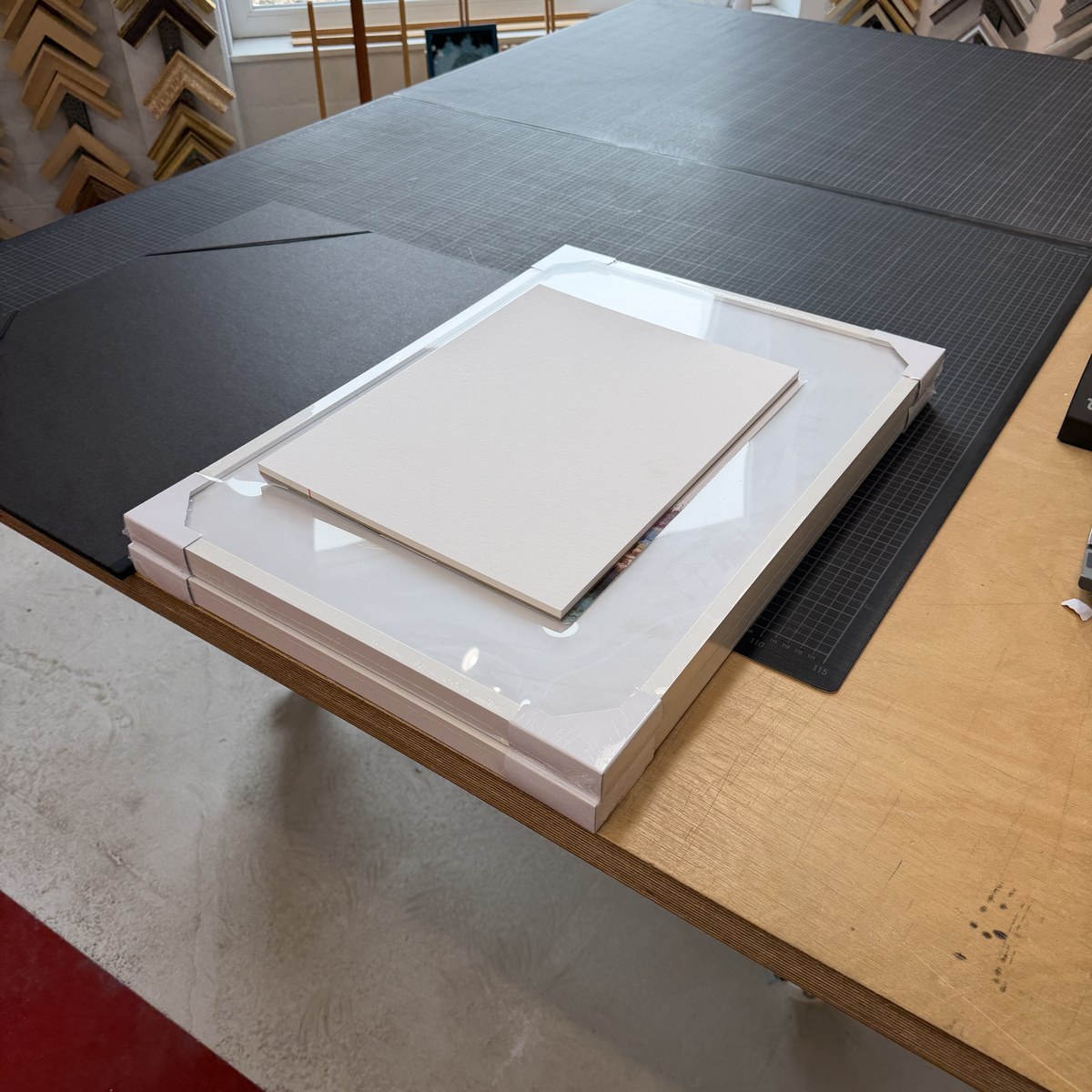
Today I was at Boesner, the art supply store, and chose the first frames and passepartouts for the eight-part series. Not to finish them yet — that happens next week. But to see something beforehand that cannot be seen on a screen: how eight Polaroids feel when they actually sit in a frame.
In the photo, a white frame lies on the cutting mat, a passepartout inside it, and beneath the passepartout a sliver of colour peeks out. That is one of the Polaroids, only laid in — nothing mounted, nothing glued. A rehearsal. The empty rectangle in the centre is the place this is all about.
Why rehearse? Because proportions lie as long as they are only imagined. How wide must the white border be so that a Polaroid, with its own border, does not look framed twice? How close may eight pictures stand next to each other and still remain a sequence rather than wallpaper? That can only be decided with the real material in the real frame, in the hand, in the light — not on a monitor.
The passepartout is not decoration. It is the distance an image needs in order to be looked at rather than stared at. The white border tells the viewer: stay one step back. With these photographs, that step is not politeness — it is a precondition.
And the frame is what I actually work with as a conceptual artist: with things that stay. A Polaroid on its own is a piece of chemistry on paper that disappears into a drawer. In a frame it becomes a work that hangs, that is passed on, that outlasts someone. The fragility remains — it is only given a form in which it is taken seriously.
The rehearsal held. Next week the first series will be completed in exactly these frames.